CarbonX PEEK+CF20
CarbonX PEEK+CF20 Carbon Fiber Reinforced Filament
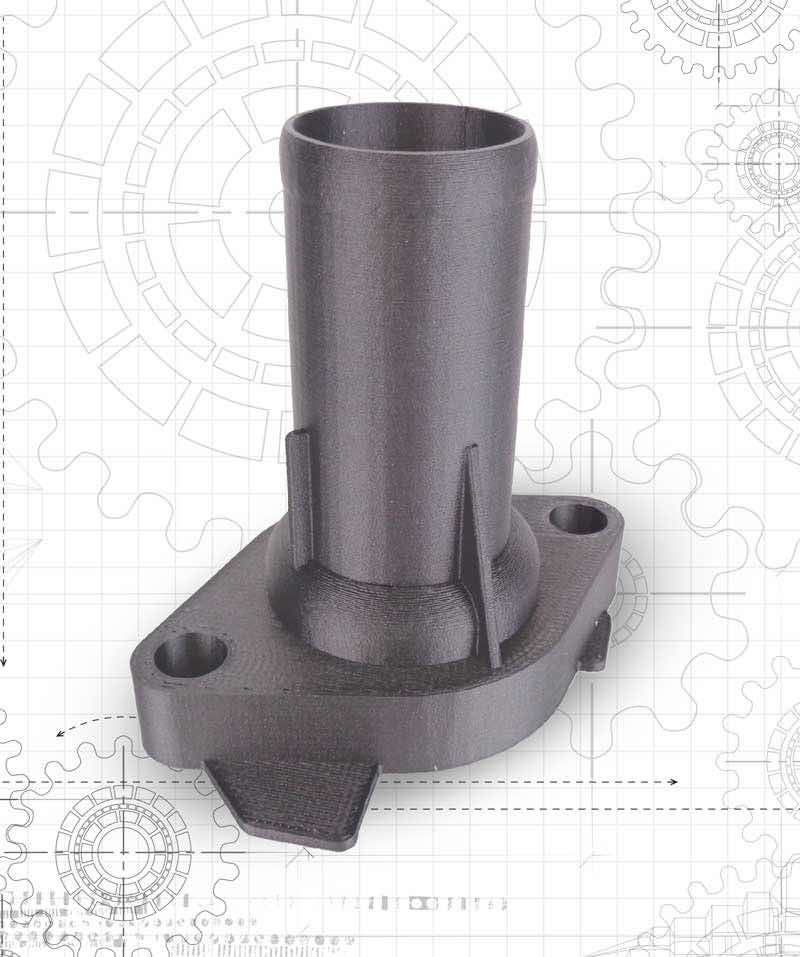
CarbonX PEEK+CF20 is one of the premier polymers in FFF/FDM 3D Printing. Made using 20% high modulus chopped carbon fiber for exceptional stiffness, strength, and dimensional stability.
PEEK+CF20 is one of the highest performance thermoplastics ever invented. It is used in some of the most demanding applications by industries such as Auto, Aerospace, Defense, Semi-conductor, and Oil/Gas. Engineers depend on PEEK for applications where failure is not an option.
CarbonX™ PEEK+CF20 Properties Include:
Superior mechanical properties, even at elevated temperatures
Excellent chemical resistance
Low Coefficient of Linear Thermal Expansion (CTE)
Near Zero moisture absorption
Low smoke and toxic gas emissions
PEEK+CF20 Thermal Properties:
Heat Deflection Temperature (HDT) of 320°C
Glass Transition Temperature (Tg) of 143°C
Melt Temperature (Tm) of 343°C
PEEK has an incredible resistance to hydrolysis in boiling water and superheated steam (useful for sterilization and autoclaving) at temperatures in excess of 250°C
Typical PEEK+CF20 Applications Include:
Seals, Gears, Bushings, Bearings, Pump, and Compressor Components
Industries served: Auto, Aerospace, Defense, Semi-conductor, Oil & Gas
Printing with CarbonX™ PEEK+CF20
PEEK has a melt temperature (Tm) of 343°C, therefore, you will need an all-metal extruder capable of reaching (and holding) temps upwards of 400°C or more depending on your specific printer. Every printer, slicer, and printing environment is different and you will need to tinker to find a process which works for you. One of the more difficult aspects of printing with PEEK was getting it to stick to the build plate.
Please note: PEEK+CF20 has a tendency to stick to metal (PEEK loves metal). Make sure to purge out your extruder completely before it cools down or you run the risk permanent clogs. Seriously, we know this firsthand.
Recommended Print Settings:
Extruder: 385-415°C
Bed Temp: 130-150°C
Nozzle: We currently recommend a hardened steel nozzle with a minimum diameter of 0.4mm.
Other: Ideal layer height is 60% of nozzle diameter. We do not recommend printing layers smaller than 0.2mm with carbon fiber reinforced filaments.
Bed Prep: Nano Polymer Adhesive or 3DXTECH Polyimide Tape
Heated Chamber: Recommended
Supports: ThermaX™ HTS High-Temp Support was specially designed to work with complex, high-temp materials like this.
Drying Instructions: 120°C for 4 hours.
New Digital Catalog
Packed with your favorite products, detailed information, and essential technical data. Whether your brand new to 3-D printing or need to find a specific filament that best fits your project, our catalog has everything you need in one easy-to-navigate place!
Check It Out

Product Performance Comparison
Explore key attributes like tensile strength, flexural strength, glass transition, and fire testing performance. Whether you're prototyping, creating functional parts, or printing detailed models, these property graphs will help you find the perfect filament for your project.
Learn More

Resources
Technical Data Sheet
Safety Data Sheet
Original: $432.84
-70%$432.84
$129.85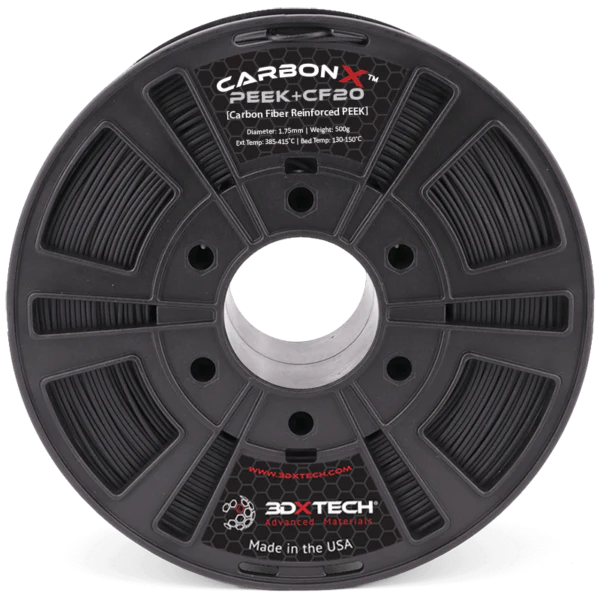
Description
CarbonX PEEK+CF20 Carbon Fiber Reinforced Filament
CarbonX PEEK+CF20 is one of the premier polymers in FFF/FDM 3D Printing. Made using 20% high modulus chopped carbon fiber for exceptional stiffness, strength, and dimensional stability.
PEEK+CF20 is one of the highest performance thermoplastics ever invented. It is used in some of the most demanding applications by industries such as Auto, Aerospace, Defense, Semi-conductor, and Oil/Gas. Engineers depend on PEEK for applications where failure is not an option.
CarbonX™ PEEK+CF20 Properties Include:
Superior mechanical properties, even at elevated temperatures
Excellent chemical resistance
Low Coefficient of Linear Thermal Expansion (CTE)
Near Zero moisture absorption
Low smoke and toxic gas emissions
PEEK+CF20 Thermal Properties:
Heat Deflection Temperature (HDT) of 320°C
Glass Transition Temperature (Tg) of 143°C
Melt Temperature (Tm) of 343°C
PEEK has an incredible resistance to hydrolysis in boiling water and superheated steam (useful for sterilization and autoclaving) at temperatures in excess of 250°C
Typical PEEK+CF20 Applications Include:
Seals, Gears, Bushings, Bearings, Pump, and Compressor Components
Industries served: Auto, Aerospace, Defense, Semi-conductor, Oil & Gas
Printing with CarbonX™ PEEK+CF20
PEEK has a melt temperature (Tm) of 343°C, therefore, you will need an all-metal extruder capable of reaching (and holding) temps upwards of 400°C or more depending on your specific printer. Every printer, slicer, and printing environment is different and you will need to tinker to find a process which works for you. One of the more difficult aspects of printing with PEEK was getting it to stick to the build plate.
Please note: PEEK+CF20 has a tendency to stick to metal (PEEK loves metal). Make sure to purge out your extruder completely before it cools down or you run the risk permanent clogs. Seriously, we know this firsthand.
Recommended Print Settings:
Extruder: 385-415°C
Bed Temp: 130-150°C
Nozzle: We currently recommend a hardened steel nozzle with a minimum diameter of 0.4mm.
Other: Ideal layer height is 60% of nozzle diameter. We do not recommend printing layers smaller than 0.2mm with carbon fiber reinforced filaments.
Bed Prep: Nano Polymer Adhesive or 3DXTECH Polyimide Tape
Heated Chamber: Recommended
Supports: ThermaX™ HTS High-Temp Support was specially designed to work with complex, high-temp materials like this.
Drying Instructions: 120°C for 4 hours.
New Digital Catalog
Packed with your favorite products, detailed information, and essential technical data. Whether your brand new to 3-D printing or need to find a specific filament that best fits your project, our catalog has everything you need in one easy-to-navigate place!
Check It Out
Product Performance Comparison
Explore key attributes like tensile strength, flexural strength, glass transition, and fire testing performance. Whether you're prototyping, creating functional parts, or printing detailed models, these property graphs will help you find the perfect filament for your project.
Learn More
Resources
Technical Data Sheet
Safety Data Sheet